Text written by Esteban V. Lloret Linares, about ‘A Quiet Reunion’ September 2026, English translation by Henri Bouillon.
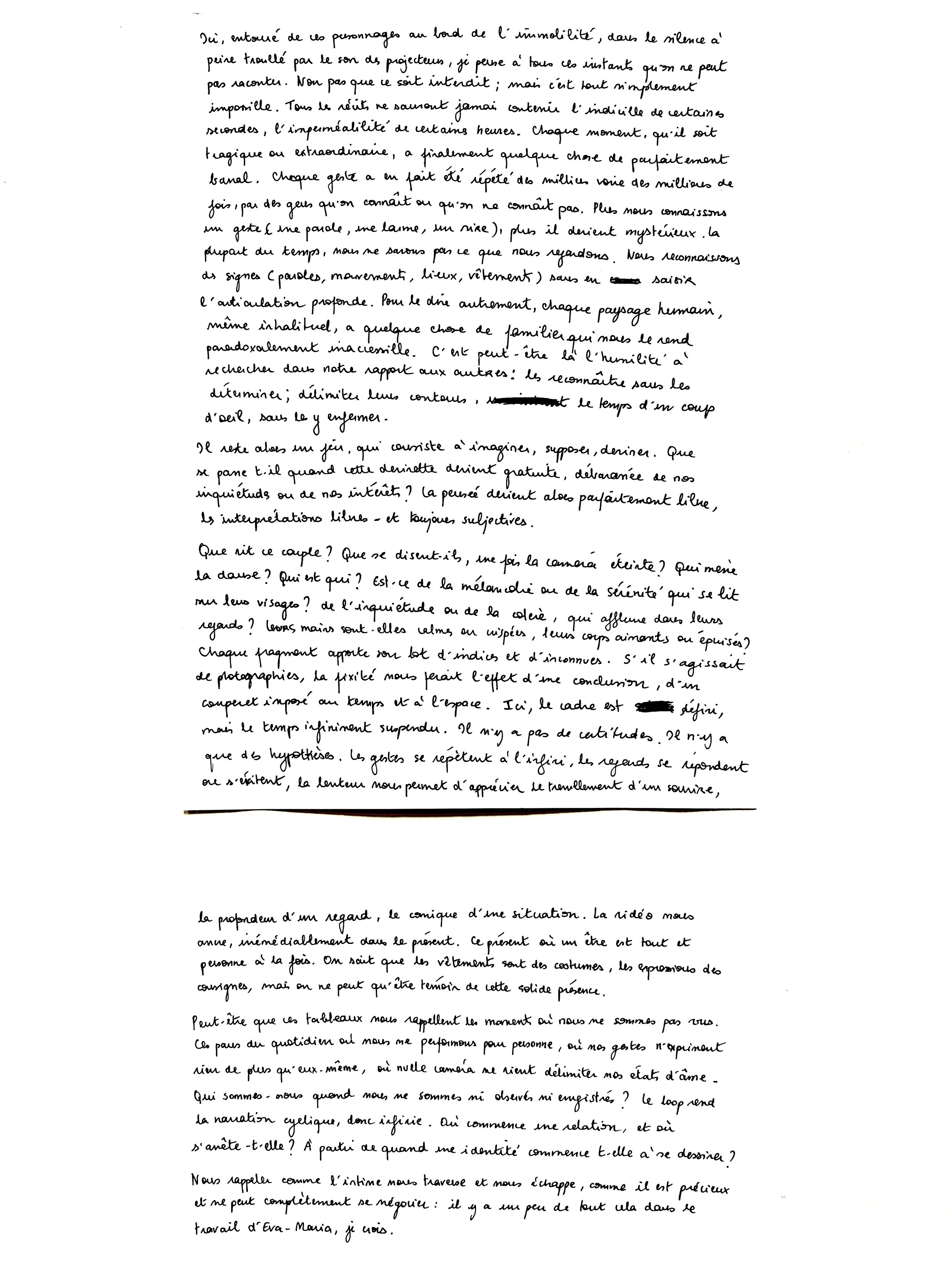
Here, surrounded by those protagonists on the verge of immobility, in the silence hardly disturbed by the projectors’ sound, I think about all the memories we cannot tell. Not that it is forbidden, but it is simply impossible. All the stories will never be capable of containing the unspeakable, the impermeability of certain hours. Each moment, whether it is tragic or extraordinary, is also perfectly mundane. Every gesture was actually repeated thousands, even millions of times by people that we know or don’t know. The more we know about a gesture (a word, a tear, a laugh), the more mysterious it becomes. Most of the time, we don’t know what we are looking at.
We recognize signs (looks, movements, places, clothes) without managing to grasp their profound meaning. In other words: every human landscape, even unusual, has something familiar that ironically makes it inaccessible. This might be the humility to aim for in our relationships with others: to recognize them without determining them; to figure them out at first glance, without locking them down. Then there remains a game involving imagination, supposition, guessing. What happens if that riddle turns out without engagement, free from our concerns or our interests? Thought becomes free, interpretations fleeting, but always subjective.
What is this couple going through? What do they say to each other, once the camera’s off? Who’s leading the dance? Who is who? Is it melancholy or serenity that we see on their faces? Are their hands calm or tense? Are their bodies loving or exhausted? Each fragment brings its share of clues and ignorance. If those were photographs, their fixation would come as a conclusion, a blade imposed on space and time. Here, the frame is defined, but time is endlessly suspended. There are no certainties. There are only hypotheses. Gestures are repeated, eyes cross or avoid each other, slowness allows us to estimate a smile’s trembling, a sigh’s depth, a situation’s caricature. Video settles us in the present time. That time in which a being is everything and nothing at the same time. We know that clothes are costumes, that expressions are instructions, but we can only witness this solid presence. The loop makes this narration infinite.
Maybe those pictures remind us of these moments in which we are not seen, this side of daily life, when we are not performing for anyone, in which our gestures do not express anything other than themselves, in which no camera defines our feelings. Who are we when we are not being looked at, or being recorded? Where does a relationship begin and where does it stop? At what moment does an identity start to take shape?
Remembering that intimacy transcends us and eludes us, how precious it is, and how it cannot be completely traded: there is a bit of all these things in Eva Maria’s work, I think.